
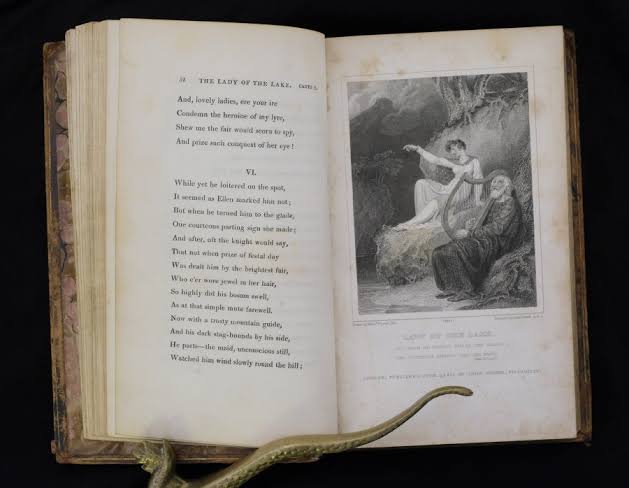
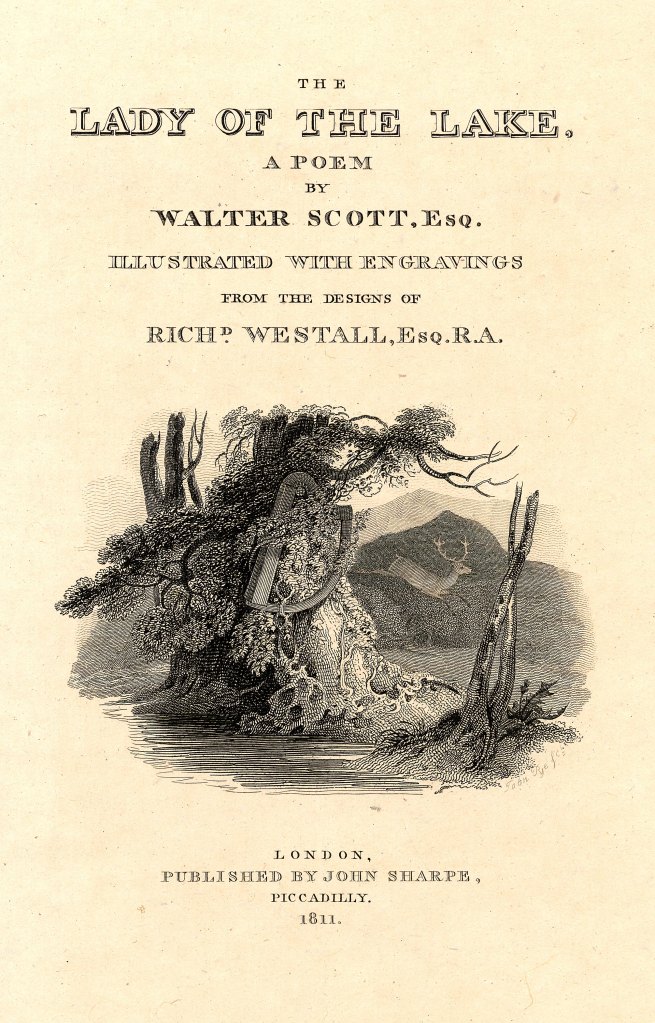
The Lady of the Lake is a narrative poem written by Sir Walter Scott. It was first published in 1810. Set in the Trossachs region of Scotland, it is composed of six cantos, each of which concerns the action of a single day.
Scott began writing The Lady of the Lake in August 1809 while holidaying with his wife, Charlotte, and daughter, Sofia, in the Trossachs and along the shores and islands of Loch Katrine, the invoking scenes that would provide Scott with the inspiration for the poem’s setting. The scene of the poem is laid predominantly in the vicinity of Loch Katrine, in the Western Highlands of Perthshire.
It is composed primarily in octosyllabic tetrameter couplets, e.g. where each verse contains eight syllables, a beat that follows a rhythm with the end rhyme coupled with the succeeding verse. Its composition mines Gaelic history to retell a well-known legend about the graceful feudal heroine Ellen Douglas. The poem is about three men competing for the hand of a beautiful woman who lives on an island in the centre of Loch Katrine in the Trossachs.
“A chieftain’s daughter seemed the maid;
Her satin snood, her silken plaid,
Her golden brooch, such birth betrayed.
And seldom was a snood amid
Such wild luxuriant ringlets hid,
Whose glossy black to shame might bring
The plumage of the raven’s wing;
And seldom o’er a breast so fair
Mantled a plaid with modest care,
And never brooch the folds combined
Above a heart more good and kind.
Her kindness and her worth to spy,
You need but gaze on Ellen’s eye;
Not Katrine in her mirror blue
Gives back the shaggy banks more true,
Than every free-born glance confessed
The guileless movements of her breast;
Whether joy danced in her dark eye,
Or woe or pity claimed a sigh,
Or filial love was glowing there,
Or meek devotion poured a prayer,
Or tale of injury called forth
The indignant spirit of the North.
One only passion unrevealed
With maiden pride the maid concealed,
Yet not less purely felt the flame;—
O, need I tell that passion’s name?”

The poet refuses to believe that such a man, with no love for his country, can exist. He says that the amount of riches, power and fame that a person achieves in foreign lands does not matter. No minstrel (a travelling singer) will sing praises for such an unpatriotic man.
“True be thy sword, thy friend sincere, Thy lady constant, kind, and dear, And lost in love’s and friendship’s smile Be memory of the lonely isle!”
The work was originally published: 8 May 1810
Links
- E-texts of The Lady of the Lake
- Other internet links on The Lady of the Lake
- Recent critical articles on The Lady of the Lake

© Susie J Folmer
 Spiritual, Creative & Academic Writing & Arts by Susie j