

Susie J Folmer, 27 July 2019
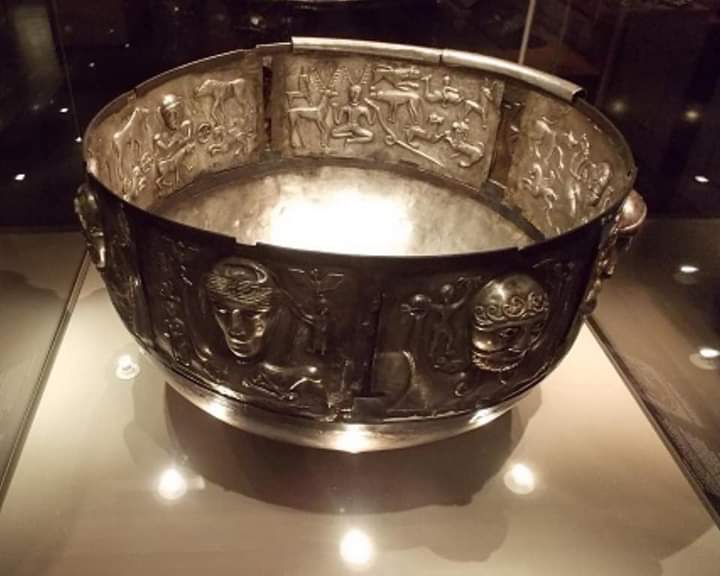
In 1891 a precious silver cauldron appeared during peat-digging in the bog Rævemosen, near Gundestrup in Himmerland, beyond the northern edge of the Celtic regions. The vessel had been deposited in the bog perhaps an immensely valuable sacrifice to the powers above. Before this occurred the cauldron had been taken apart. The rim and the large silver plates, which make up its sides, were taken off and placed in the bottom of the vessel. This magnificent cauldron is one of the most important and intriguing finds from ancient Europe. It reveals connections between communities thousands of miles apart.
Some ancient people of Denmark believed that gods lived in the bogs. This was because the natural peatlands provided many blessings that were critical for their survival. Peat provided fuel for fires that warmed their longhouses. The makers of linen textiles soaked their flax and hops in the bog water for the retting process. Additionally, iron smelters collected iron ore from the bogs. As a result of their many resources, the bogs evoked great reverence and appreciation.
The Gundestrup Cauldron’s motifs draw the observer into an alien universe far from that of the people who deposited it in the bog. The depictions are represented in a foreign style, indicatimg that the cauldron originally came from a distant area to the south or southeast. Exactly where it was made is still open to question. Perhaps it was a gift to a great chieftain or could it have been?
This cauldron is notable for being the largest known piece of European Iron Age silver work. Thus, much attention has been paid by scholars to this vessel. This is especially true with regards to its high quality workmanship and complex iconography, which have fueled debate about the origins of this object. The style of the designs suggests that it was made further east, in Bulgaria or Romania. At present, there are two main camps in the debate, one arguing that the cauldron is of Gaulish origin, while the other argues that the vessel is actually of Thracian origin. Some scholars say the spectacular vessel it is an intermingling of different cultures.
Sophus Müller, a Danish archaeologist, reassembled the cauldron after the discovery, and revealed;
“The outer panels show gods and goddesses. On the left a goddess with two birds is having her hair braided. On the right a god with a forked beard holds two humans.
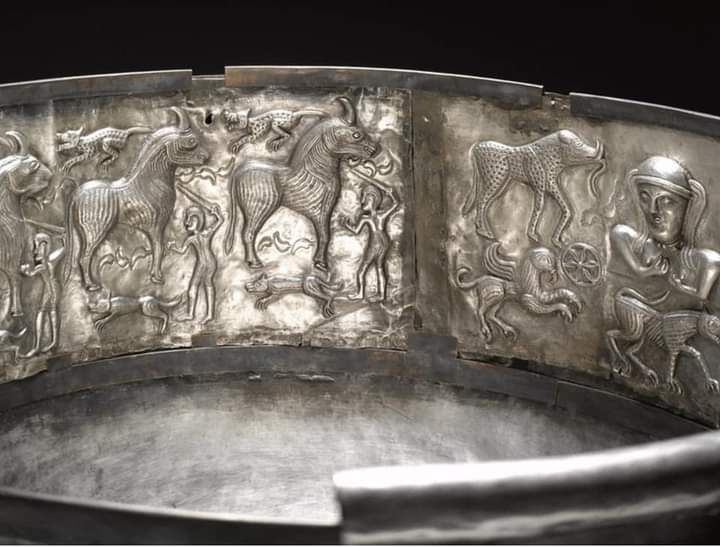
The enigmatic scenes inside depict people alongside fantastical creatures. The cross-legged man with antlers holding a horned snake may be a god. Behind him a small figure rides a fish. The goddess on the left is surrounded by wild and strange beasts – the ones with long noses may represent elephants.
The Gundestrup cauldron was probably reserved for important rituals. It is likely that most people would have viewed it from a distance, seeing only the forbidding faces of gods and goddesses on the outer panels. The fantastical scenes on the inside would have been revealed to those allowed to experience the cauldron close up. One panel shows three people slaying bulls. The leaf motifs coming from the bulls’ necks are repeated throughout the designs. They may simply be decorative, or perhaps here they represent blood.
Pictures inside might show a scene from an ancient myth. Warriors on foot and horseback wear helmets, and hold spears and shields. Three musicians bring up the rear, blowing boar-headed war horns. They approach a giant figure who dips a warrior into a cauldron. Perhaps this shows a sacrifice, or a powerful god or goddess bringing a dead warrior back to life.
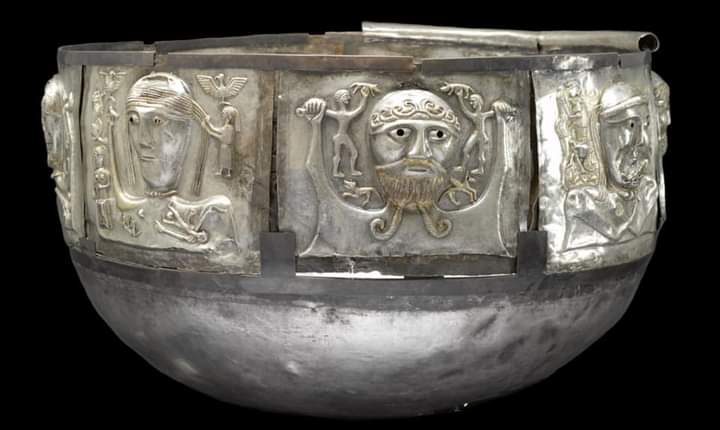
Faces glare from the outside of the cauldron. Their staring eyes once held glass insets. They are probably gods and goddesses, as they perform superhuman feats. One grasps a deer in each hand. Another holds two fantastical serpents, while beneath his gaze a double-headed beast devours two tiny human figures. Inside the cauldron, another panel shows a god next to a wheel, perhaps a symbol of his powers. Next to him is a warrior in a horned helmet, surrounded by hounds and griffins.”
Ultimately, we may never know exactly what the purpose of the Gundestrup cauldron was. We may never discover why someone had carefully buried it in the peat bog. It certainly meant enough to someone to transport it or have someone transport it to Denmark from a very faraway place
Sources:
https://www.ancient-origins.net/artifacts-other-artifacts/gundestrup-cauldron-largest-and-most-exquisite-iron-age-silver-work-europe-020989
https://en.natmus.dk/historical-knowledge/denmark/prehistoric-period-until-1050-ad/the-early-iron-age/the-gundestrup-cauldron/
https://britishmuseum.tumblr.com/post/132087416007/the-gundestrup-cauldron
https://www.historicmysteries.com/gundestrup-cauldron/
http://www.native-science.net/Gundestrup-Cauldron.htm
Susie j Folmer, 2019 ©
 Spiritual, Creative & Academic Writing & Arts by Susie j