Sometimes you must begin at the end to understand that in the beginning and in between there are many streams, rivers, branches to explore. The ending of a story is often the beginning of many more.
Susie j Folmer, 2022
Terms such as ‘apocalypse’, ‘twilight of the gods’, ‘the doom of the powers’, ‘the fate of the gods’ and ‘the end of time’ have been used to describe Ragnarök which are the events leading up to the ill-fated destruction of the cosmos and everything in it. It may be a timely thing that I sit and consider drafting this article at a time in the world when we may be headed in the same direction, the ending, and why it is time to explore the Ragnarök events that we know from Old Norse Mythology. This significant story describes how the world might have come into shape and would end according to Old Norse Mythology.
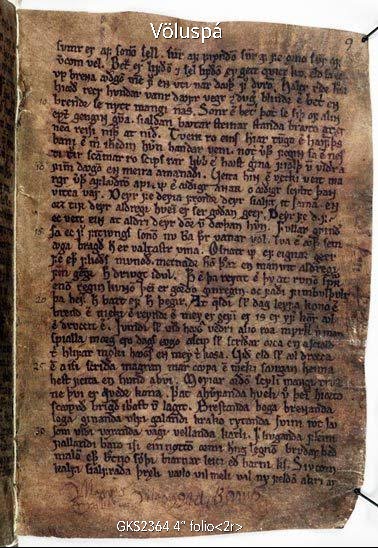
Eddic literary sources such as: Völuspá, Vafþrúðnismál, Helgakviða Hundingsbana II, Gylfaginning, Oddrúnarkviða and Baldrs Draumar offer insight into how Ragnarök was told of and interpreted in early literature in at times a cleverly cryptic way while other literature offers a more detailed and creative account. Ragnarök can be viewed as the overarching prophecy told to us in Völuspá which refers to the great upheaval of social, environment and natural order of the world and the ending of what is known. Author, Maria Kvilhaug in ‘Seed of Yggdrasill’ offers us a more literal translation of Ragnarök, “The Destinies of the Rulers”. “Ragna is genitive plural of Reginn (“Ruler”), whereas rök (n.pl.) refers to “developments, “circumstances”, “causes”, “ends” or “destines”. The rulers in question are usually thought to be the gods…. the word rökr (n.sg) refers to “twilight”.” (Kvilhaug M, 2020, p 514)
It appears throughout the Eddic writings that the pantheon of gods is under constant threat and always looking ahead for where those threats might come, building giant walls around their realm, and often going on quests to rescue kidnapped goddesses who provide them eternal life. In these writings we also see Óðinn seeking ancient wisdom and in his quest for this seeks out the Völva in Völuspá to ask her to investigate the past, present, and future and for him she recounts the events that led up to Ragnarök and all that she could tell would occur and come of it. Óðinn knows that Ragnarök is the ultimate battle, and it will be the end of the gods, destroying the world as they know it to be.
Throughout the literature it also may seem as if Óðinn is trying to delay the inevitable and is taking precautions in actions such as in the binding of Fenrir to postpone what is fated, and even though he knows of the events and of Loki’s instrumental role in the last battle he still makes a blood oath with him and brings him into the Ásgarðr fold. Was Óðinn attempting to influence and change what was fated? In life if we try to avoid certain outcomes, do we then set in motion a chain of events that will ensure the unwanted conclusion? I think the message here is to be careful with knowledge and not deliberately upset the laws of nature, or we too may face consequences we didn’t see coming.
Völuspá, in my opinion, is one the most important and insightful pieces of all the Eddic poetry and contains much for the seeker to find in the riddles to unravel and complex metaphors, parables, and kennings. As Maria Kvilhaug importantly highlights in her invaluable body of work, ‘The Seed of Yggdrasil’, “We live in a time and age where we have learned to read our myths literally…. thus, have been conditioned to think of dooms day prophecies as literal descriptions of an apocalypse that is to take place in the near future….”. In this statement Maria is giving us a marvelous indication of what can really be discovered in exploring this story in Old Norse Mythology. It cannot simply be a fable of good versus evil and good wins the day, as Old Norse-Icelandic, skaldic-eddic literature is distinct in its way of hiding things in plain sight, and in its unique and complex legendary literature style.
This colossal event ‘Ragnarök’ comes in the form of a battle between order and chaos, leading to deaths of many gods and their adversaries and the birth of a new world order. While there is a slight contradiction in the ultimate ending and rebirth aspect which is possibly where the reader may be able to discern the pre and post Christian influences within this breadth of literature, and in line with this we see two dominant versions of the myth of Ragnarök seem to emerge from the Norse sources. In one, Ragnarök is the ultimate end of the cosmos, and no rebirth follows it. In the other, there is a rebirth. Christian writers would not recount stories of pagan fully if at all which leaves us at times with patchy and contradictory records and these inconsistencies emerge. Yet this should not render all Old Norse-Icelandic literature invalid as much was preserved through the creative and unique skaldic oral history and through those who did write these orally told stories down when ink and vellum arrived in Northern European Scandinavia
Simek explains Ragnarök as, “the final destiny of the gods. The term for Nordic eschatology in the Edda…. Nordic cosmology includes a destruction of the world which involved the gods as well as man. Thus, the presence of the gods is limited and not without reason: like man they have much to blamed for because of crimes and wars.” (A Dictionary of Northern Mythology, pp259, 1996)
Norse mythology tells us of ‘fimbul-winter’ (fimbulvinter / fimbulvetr) which is the monstrous winter three times the length of a normal winter with no summers, and when the sun has no force at all. In Snorri Sturlusson’s Prose Edda Ch 51 ‘The High One Reveals the Events of Ragnarok we hear when Gangleri asked, ‘What is to be said about Ragnarok?’ that ‘High’ describes this time by replying,
“There are many important things to be said about it. First will come the winter called Fimbulvetr (Extreme Winter). Snow will drive in from all directions; the cold will be severe, and the winds will be fierce. The sun will be of no use. Three of these winters will come, one after the other, with no summer in between. But before that there will have been another three winters with great battles taking place throughout the world.”
Byock J (trans.) The Prose Edda, 2005
This savage weather is matched by moral chaos where brothers fight and kill their own brothers. The giant wolves swallow the sun and moon, and the stars form the nights sky disappear before a massive earthquake brought on by Loki’s final convulsion brought on by the venom of a snake uproots trees as the earth shakes, and the fetters and bindings holding giants and monsters controlled by the gods break. This leads to moral, social, and topographical chaos. One may see that the term fetters in the poetry that describes these events may also refer to the “fetters” that bind and hold social order in place. Völuspá st.45 paints this picture in a stark and bold way.
| Brœðr muno beriaz ok at bǫnom verða[z] muno systrungar sifiom spilla. Hart er í heimi, hórdómr mikill —skeggǫld, skálmǫld —skildir ro klofnir— vindǫld, vargǫld— áðr verǫld steypiz. Mun engi maðr ǫðrom þyrma. | Brothers will fight and kill each other, sisters’ children will defile kinship. It is harsh in the world, whoredom rife – an axe age, a sword age – shields are riven – a wind age, a wolf age – before the world goes headlong. No man will have mercy on another. |
Völuspá stanza forty-five highlights a major taboo among the breakdown of social order when “brothers will fight and kill each other, and sisters’ children will defile kinship” as in Old Norse society those kinship ties were what bound them together with such loyalty as to defend one another to death if necessary. Frith, kith, kin and grith values were held in highest esteem and were the foundation of societal structures.
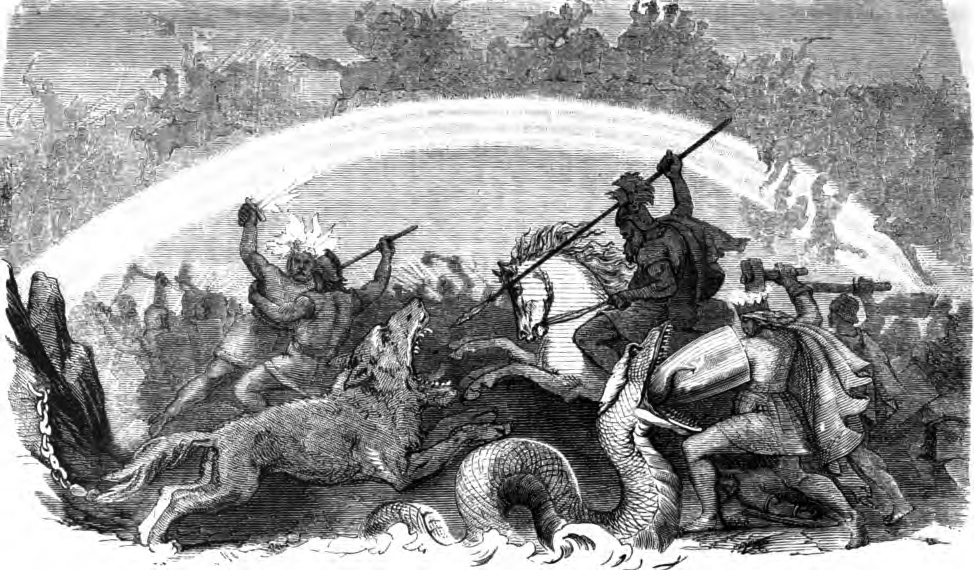
The last battle of the gods and giants fought amongst a world of flames which reaches the heavens. The gods with their supernatural powers and attributes are not flawless and their efforts are often hampered by their quasi-human nature. The pantheon is engaged in an ongoing struggle with giants, at times serious, and at other times humoristic and farcical. This ultimate battle proves fatal for both sides, gods, and giants alike. Many of the events leading up to Ragnarök become intensified by the premature death of Baldr, the much-loved son of Óðinn and Frigga.
Importantly, and perhaps giving us today some sense of hope, the seer in Völuspá also does not end her prophecy with the end of the war and world as it was but she goes on to tell of Baldr in the underworld and that he and the children of other gods will rebuild society, ushering in the new world, or the ‘golden age’ of society. It is Baldr who is said to be reborn when the new world emerges. Baldr symbolizes the spring, the thaw, new beginnings in his place in the old stories. To save Baldr and ensure his life is not ended Óðinn takes a journey to the underworld to make a deal with Hel. She asks in return for Baldr that all in the realms should weep for Baldr and then she would release him. One giantess refuses to weep for Baldr so he must stay in Hel with Hel. The gods retaliate by taking Loki, who they hold responsible for Baldr’s death, and have him bound with his son Narfi’s entrails and a venomous snake is hung above his head dripping poison on him which causes him to shake so violently the earth shakes. Although his wife Sigyn attempts to catch the venom in a bowl she holds above his head some still drips on Loki causing him to convulse and shake so much so the world shakes.
The fetters that bound Loki and all those who the gods had secured to create the world that they had are finally broken lose from all the shaking. The oceans surge onto land and the Jörmungandr, the Midgard Serpent, in a rage will come ashore to join the fight spitting poison into the sky and sea from where the sons of Muspell will come with Surtr in the lead to ride over Bifrost breaking it. Heimdall blows his horn, Gjallarhorn, to waken and alert the gods and goddesses who hold a parliament and prepare for their ultimate battle. “Axe-age, sword-age, storm age, wolf-age, ere earth is overthrown. Three cocks will crow, one in the gallows-tree, one in Valhalla, and one in Hel; the pursuing wolves will swallow up both Sun and Moon, Earth’s bonds will crack, the mountains fall.” (Jones G, 173, p318)
Is this story simply about an ultimate ending when such complex parables, riddles and ciphers are weaved throughout it? This tremendous battle, Ragnarök, and all the literature that has included it are worth the time to study to understand the complex narratives being told in more detail. When we start to consider the motif’s gods and entities symbolize a whole other story emerge which reveals the ethos, norms, mores, value base and customs of the time. After the battle is over. while the gods and entities are burned and killed, all mankind at the time are destroyed, there will be a rebirth of a new world. Every ending has a new beginning. Baldr is reborn as are others and a new realm is created where Asgard once was, and a new earthly realm will be born. As Hurstwic recounts.
“Two humans, Líf and Lífðrásir, who hid themselves deep within Yggdrasil, will see light. For although the sun was eaten by Skoll, she will give birth to a daughter no less fair, who will follow the same sky-path and light the world. Líf and Lífðrásir will have children; there will be new life everywhere on earth. With the rebirth of the world after Ragnarök, the golden age of the Norse gods will return. A radiant hall will rise that no flames of perdition can touch. In that hall, the noble warriors who fought alongside the gods will live on in joy. The ignoble will be carried away by a dragon to be eaten. The gods will find the golden playing pieces of their board game in the shining meadow, and they will build on the triumphant foundations laid down by Óðinn.”
Hurstwic, https://www.hurstwic.org/history/articles/mythology/myths/text/ragnarok.htm
Along with literary sources archaeological evidence such as the Rök stone, Thorwald’s Cross, Gosforth Cross, Ledberg stone, and the Skarpåker stone add layers of meaning for us to interpret the interesting meaning of Ragnarök in their interesting depictions that match up to later Eddaic prose and poetry that tell of the Norse Mythological end of days, Ragnarök. From comparing these to the literature we can see this story survived a long history and was not a construct of the new Christian dogma that had come into being after the year 1000AD in Iceland where much of this literature was scribed.
There are several different theories regarding what Ragnarök was, and what it meant, in the past, the present, and the future. Several historians, researchers and authors have offered interesting insights. I think we will all interpret aspects of Ragnarök differently so there will not be any one straightforward way to answer what is or what was Ragnarök. While this article is focused on mythological and cosmological aspects, I encourage the reader to delve into the myriad of emerging ideas that surround this key area. Scholars such as Dr Rune Hjarnø Rasmussen present compelling information on the current state of world affairs and the climate catastrophe we now face. (Links to Rune’s work are listed below)

Could Ragnarök described in literature have been based on a considerable environmental disaster that led to great social change? Is Ragnarök a prophecy telling of the end of everything, the destruction caused by man, gods, and the earth itself as a living being? Are people reborn into a new world, or is the end really the ending? There are many questions, there are some great interpretations of literature, which offer sound philosophical reasoning. Nordic Animism offers some incredibly interesting and profound videos and reading that cover this area and I urge you to seek those out (links below).
Like many of the Eddic poems and prose pieces we still have today, it may be left to individuals and groups to decide what they believe it to be. The intimate relationship between myth, religion, science, psychology, and philosophy are most evident in this theme of Eddic lore, and various aspects of life’s mysteries are addressed by these different disciplines. Merely the act of delving into these ancient concepts could be the reason they were left to us. As there is no written record of how Ragnarök may have once been understood today we must rely on delving into the deep realms of Norse Mythology, history, and culture to understand it and decide what we believe it to be. Therefore, there will always be areas of gray, areas of uncertainty and areas where there are no definitive answers to many questions. The nature of oral history often leaves us with these lingering questions based on the lack of concrete information. Equally, so too does oral history correct, confirm, and add to the historical records.
Susie J Folmer, September 2022
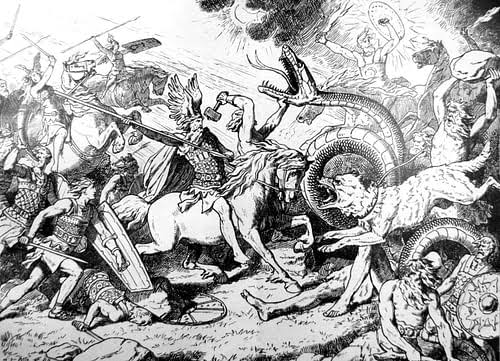
Illustration by Johannes Gehrts
I wish to also give special thanks to Cody Shaffer of Eldrvak music for his song “…And The Sky Turned Black” that I listened to, and was inspired by, while I dove deeply into this complex area of Norse Cosmology – you can find the song here – https://www.youtube.com/watch?v=rkfZWi-bVcU
References & Images:
- Andersson H, Image: Rök runestone, Sweden, Archaeology Magazine
- Bellows, Henry Adams, (2004). The Poetic Edda: The Mythological Poems
- Byock, JL., 2005, The Prose Edda
- Dronke, Ursula Trans. (1997). The Poetic Edda: Volume II: Mythological Poems
- Fazio, Michael W. Moffett, Marian. Wodehouse, Lawrence (2003): A World History of Architecture, ss. 201.
- Hopkins, Joseph S. (2014). “The ‘Viking Apocalypse’ of 22nd February 2014: An Analysis of the Jorvik Viking Center’s Ragnarök and Its Media Reception”
- Hurstwic, https://www.hurstwic.org/history/articles/mythology/myths/text/ragnarok.htm
- Jones Gwyn, 1973, A History of Vikings
- Kvilhaug M., 2020, The Seed of Yggdrasill
- Orchard, A., 2011, The Elder Edda: A Book of Viking Lore
- Orchard, Andy (1997). Dictionary of Norse Myth and Legend
- Simek R., 1996, A Dictionary of Northern Mythology
- Wikipedia, https://en.wikipedia.org/wiki/Ragnar%C3%B6k
- Wikipedia, https://no.wikipedia.org/wiki/Ragnarok
- Zoëga, Geir (2004) [1910]. A Concise Dictionary of Old Icelandic
More Handy links:
Nordic Animism https://www.youtube.com/watch?v=Xj0GBGj6QeE&ab_channel=NordicAnimism – The video talks about Ragnarok, the climate/social collapse. The video is based on an article in the Danish Newspaper Politiken, that I co-authored with a group of scholars of religion (See: https://nordicanimism.bliz.dk/blog/ra… ). This, however, is an updated version of my thinking with the Ragnarok prophecy
Nordic Animism https://www.youtube.com/watch?v=a_chnIBCiZM&ab_channel=NordicAnimism – The Völuspá, An Eddic Prophecy of Climate Ragnarok
Eldrvak – https://www.facebook.com/Eldrvak

© Susie J Folmer
 Spiritual, Creative & Academic Writing & Arts by Susie j
I love this and I’m so happy you have started the blog! Long overdue. One concept that I love to think about is Ragnarok being somewhat of a representation of the earth’s cycles regarding seasons or renewals. I’ve never quite thought of it from the Christian perspective, but I see it as more of an earthly perspective. We have many seasons that come and go, but the fact that they come and go is constant.
LikeLiked by 1 person
Yes, it is a theme I have spent many hours pondering and wondering about. I always end up with adding more questions to an ever growing, unanswerable list. One period I seem to return to is the middle of the sixth century which then was a time when “mysterious clouds” darkened the skies with what we know now to have been “a cataclysmic volcanic eruption in Iceland spewed ash across the Northern Hemisphere early in 536. Two other massive eruptions followed, in 540 and 547. The repeated blows” (Climate Change Institute of The University of Maine). I wonder how much of an influence having lived through years of volcanic ash, darkness, crop failings, famine and massive shifts in society has played into oral history and literature. If we look from an animist perspective the dots connect in such a fluid way that it makes a lot of sense that this dreadful experience could have been the paint that gave detail to the canvas in telling’s of this story. Medieval scholar Michael McCormick wrote that 536 was the worst year in history to be alive. “It was the beginning of one of the worst periods to be alive, if not the worst year.” This, and other research certainly helps us understand where these narratives were influenced. I imagine being in a hut in darkness and an elder telling us stories of how the sun has been eaten by the wolf and we were facing the beginning of the end.
LikeLike